

PERFECT
SMILE VENEERS
เอกลักษณ์รอยยิ้มพรีเมียม
ที่สะท้อนความเป็นคุณ
PERFECT
SMILE VENEERS
เอกลักษณ์รอยยิ้มพรีเมียม
ที่สะท้อนความเป็นคุณ

Transform Your Smile to Absolute Perfection
Veneers are an excellent solution for comprehensively and quickly correcting cosmetic dental issues. They can transform teeth with a wide range of problems, restoring them to a beautifully aligned, white, clean, and natural appearance.
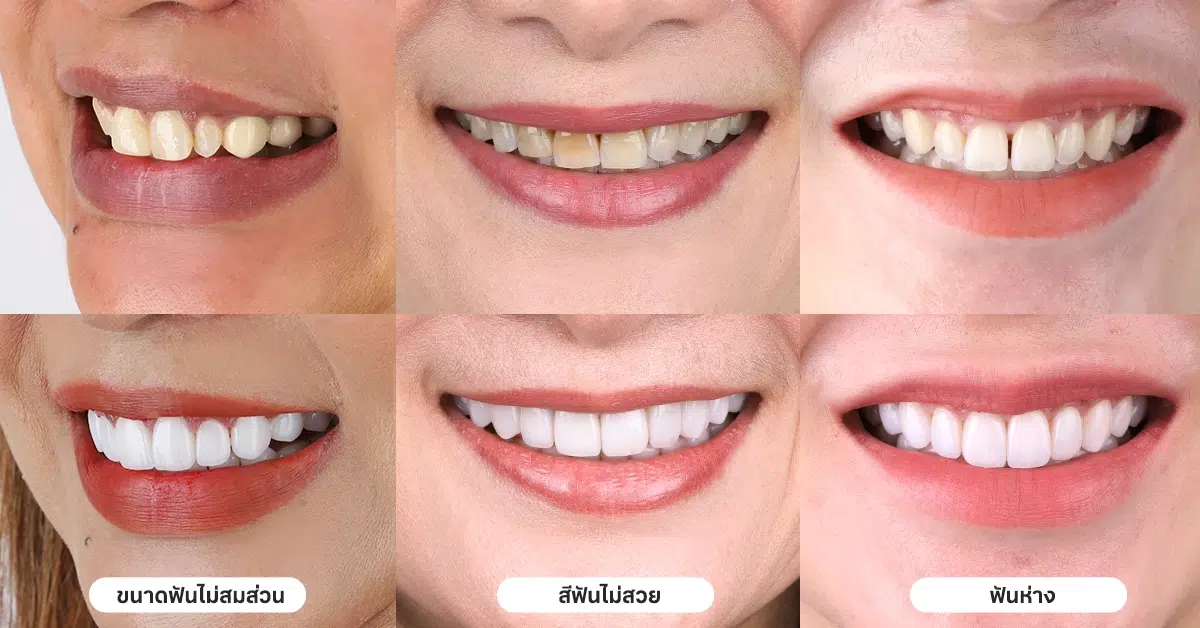
6 Dental Problems That Veneers Can Fix
- Darkened, yellowed, or unevenly colored teeth
- Gapped teeth or spaces between teeth
- Chipped or cracked teeth
- Worn or eroded teeth that appear shorter
- Irregularly shaped or poorly sized teeth
- Slightly crooked or crowded teeth in cases where orthodontics are not desired
Who are Veneers Suitable For?
Once you can compare the pros and cons of each type of veneer but are still unsure if you are a suitable candidate for this treatment, let’s explore the characteristics of individuals who are ideal for veneers. This will help ensure you achieve the best and most lasting results.
1. Composite Veneers
This involves the direct application and sculpting of dental filling material (composite resin) onto the tooth surface, which is then hardened with a special light. It is a popular method for correcting minor issues.
Pros:
Affordable Price: Lower cost compared to porcelain veneers.
Fast: Can often be completed in a single dental visit.
Easily Repairable: If chipped or broken, it can be spot-repaired.
Minimally Invasive: Requires very little removal of natural tooth structure, and in some cases, none at all.
Considerations:
Lifespan: Averages around 5-7 years.
Stain Resistance: Can stain more easily from food and beverages, and the color may change over time.
Aesthetics: While natural-looking, the translucency and luster may not match that of porcelain.
2. Porcelain / Ceramic Veneers
hese are high-quality, custom-made ceramic shells that are meticulously crafted in a dental laboratory to fit each patient’s teeth perfectly before being permanently bonded to the tooth surface.
Pros:
Superior Aesthetics: Offers the most luster, translucency, and color matching to natural teeth.
Highly Stain-Resistant: The material is resistant to staining, so the color does not change over time.
Long Lifespan: Highly durable and can last for 10-15 years or more.
Biocompatible: Does not cause irritation to the gums.
Who are Veneers Suitable For?
After thoroughly comparing the pros and cons of each type of veneer, you may still be unsure if you are a suitable candidate for this treatment. Let’s explore the characteristics of individuals who are ideal for veneers to ensure you achieve the best and most lasting results.
Veneers are suitable for patients who want to achieve a perfectly beautiful smile, whether you have unattractive teeth, very yellow teeth, or uneven tooth color. However, here are the types of dental problems that veneers are designed to solve
Teeth that are dark, yellow, or unevenly colored and cannot be corrected by teeth whitening.
Teeth that are chipped, cracked, broken, or uneven in size.
There are gaps between the teeth.
Slightly crooked/overlapping teeth for those who do not want to spend time on orthodontic treatment.
Case Examples of Ceramic Veneer Patients

Book a Consultation
Easy Online Booking for Your Smile Makeover.
Please fill out the form below to schedule an appointment with Karin Dental Clinic. Our staff will contact you via phone or email to confirm your appointment as soon as possible.
Q&A
Frequently Asked Questions
We’ve compiled a list of common questions to help you better understand oral healthcare and the services we offer.
Generally, dentists recommend a dental check-up and professional teeth cleaning (scaling) every 6 months. This helps to prevent potential oral health problems such as early-stage cavities or gingivitis. Early detection makes treatment easier and less expensive.
If you are experiencing a dental emergency—such as severe tooth pain, a dental accident, a cracked or broken tooth, or significant swelling—please contact the clinic immediately to schedule an urgent appointment. Kindly call us at 065-023-1444 so our staff can assess your situation and provide initial guidance before you come in for treatment.
We place the highest priority on our patients' comfort. Before beginning any procedure that could potentially cause discomfort, our dentists always administer a highly effective local anesthetic to ensure you feel no pain during the treatment. Furthermore, our team provides constant care and communication throughout your appointment to help you feel as relaxed as possible.
Our clinic offers several options for replacing missing teeth, including:
Dental Implants: This is the solution that most closely mimics natural teeth. They are strong, durable, and aesthetically pleasing.
Dental Bridges: Ideal for replacing one or two missing teeth, bridges are anchored to the adjacent natural teeth for support.
Removable Dentures: A suitable option for replacing multiple teeth or a full arch of teeth.
Our dentists will help assess your condition and recommend the most appropriate solution for you.
Creating a positive attitude is essential. It's important to speak about visiting the dentist in a positive light. For example, say something like, "The dentist will help count your teeth and make them strong and healthy." Avoid using phrases such as "it won't hurt" or "don't be afraid," as this can inadvertently suggest to a child that there is something to be anxious about. At our clinic, we provide a friendly atmosphere with dentists who understand children, all to create the best possible experience for them.
contact us
Let Us Care for Your Smile And Make You the Next Success Stor
Experience professional, heartfelt dental care with our expert team and relaxing atmosphere.
We’re here to create your dream smile and keep your teeth healthy.